The 6 Levels of AI Autonomy: From Assistant to Autonomous Operation
An evidence-based SXP framework for separating operational autonomy from product readiness, quality, and human governance.
What you will take away
- Automation repeats a procedure; autonomy carries bounded responsibility for decisions and outcomes.
- SXP separates operational autonomy L1–L6 from Product Readiness R0–R5.
- The right target is the lowest level that removes a real recurring burden safely and economically.
- Human governance remains above every level, especially for publishing, money, safety, and irreversible change.
“AI agent” now describes everything from a chatbot that drafts an email to a production system that plans work, invokes tools, checks results, recovers from failures, and keeps operating. That vocabulary gap is not harmless. It makes teams compare unlike systems and encourages capability claims that outrun the evidence.
SXP created the SXP AI Autonomy Framework around a more useful question:
How much operational responsibility can this system safely own?
This is an original SXP taxonomy informed by established work in systems engineering, reliability, AI evaluation, risk management, and governance. It is not an ISO, NIST, or universal industry standard, and it is not a certification scheme.
Three distinctions that prevent most category errors
Automation is not autonomy. Automation executes a known procedure consistently. Autonomy begins when a system can choose bounded actions from observed state, evaluate the outcome, and take responsibility for what happens next.
An agent is not an agentic system. A single agent can choose tools during one session. An operational agentic system also needs durable state, task contracts, quality gates, bounded permissions, retries, audit history, escalation, and a way to resume after the original session disappears.
Autonomy is not product quality. A simple static service can be exceptionally mature with low autonomy. A spectacular autonomous demo can still be unsafe, unreliable, and unusable by real customers.
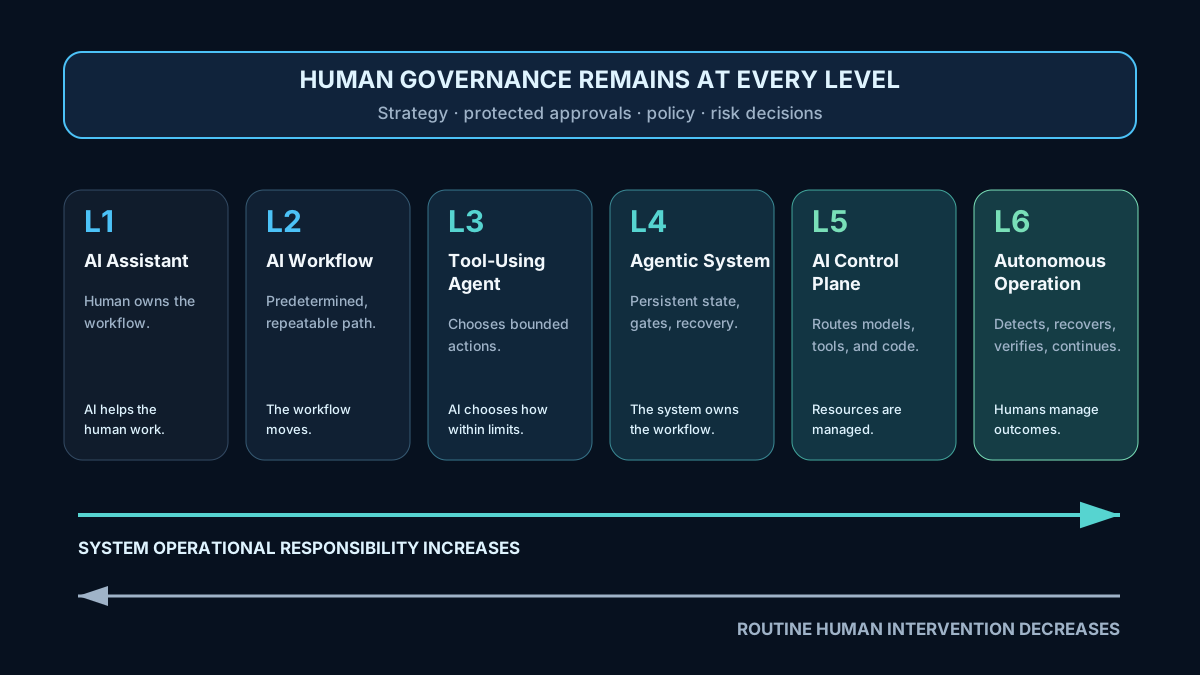
L1–L6: increasing responsibility, not increasing intelligence
L1 — AI Assistant
AI helps a person do the work. The human starts the task, supplies context, judges the result, and performs the next action. Summarising a document or drafting copy for human review belongs here.
L1 can be enormously valuable. It simply means operational responsibility remains with the human.
L2 — AI Workflow
A repeatable trigger follows a mostly predetermined path through AI and deterministic steps. Equivalent inputs take a reproducible route, and failure has an explicit outcome rather than disappearing silently.
A scheduled analytics job that collects data, checks freshness, generates a bounded insight, and delivers a report is an L2 pattern when software—not the model—controls the sequence.
L3 — Tool-Using Agent
The agent receives a bounded goal, inspects state, selects permitted tools or actions, validates the result at least once, and stops under explicit conditions. The decisive evidence is an observed inspect → act → observe loop. A tool-calling interface that has never completed such a loop does not prove L3.
Guardrails become mandatory here because choosing an action gives the system real authority.
L4 — Agentic System
The system owns the workflow, not merely one agent session. It has authoritative persistent state, structured task contracts, deterministic quality gates, bounded retry and failure classification, an audit trail, explicit approvals, least-privileged permissions, and resumability.
A useful test is session replacement: if the model, agent, or interactive session disappears, can ordinary execution continue from trustworthy state? If someone must retell the whole story, L4 is not yet proven.
L5 — AI Control Plane
The system manages models, agents, tools, deterministic code, and runtimes as resources. It chooses among them from task characteristics, observed quality, cost, policy, and current state. It can prefer code, cache, or structured data before making an unnecessary model call, and measured results can alter subsequent routing.
Agent count proves nothing. Ten agents behind static routing do not make a control plane if quality or resource state cannot change which capability runs next.
L6 — Autonomous Operation
Humans govern outcomes, policy, and exceptions while the system handles routine operation over time. It detects ordinary failures, diagnoses and recovers, verifies the recovery, and continues within tested rollback, resource ceilings, quality objectives, incident evidence, and protected approvals.
L6 requires repeated production history. An unattended coding session—even one that repairs several bugs—is development evidence, not proof that the production operation can recover by itself.
Product Readiness R0–R5 is a separate axis
SXP tracks readiness independently:
- R0 Concept — an idea without a credible working product
- R1 Prototype — the core idea works but is not dependable
- R2 Functional — the primary workflow works with basic deterministic QA
- R3 User Trial — intended users can try it through an explicit path with known limitations
- R4 Production — release, rollback, monitoring, security, and quality requirements are satisfied
- R5 Proven / Mature — repeated real use, stable quality, operating history, and measured feedback guide iteration
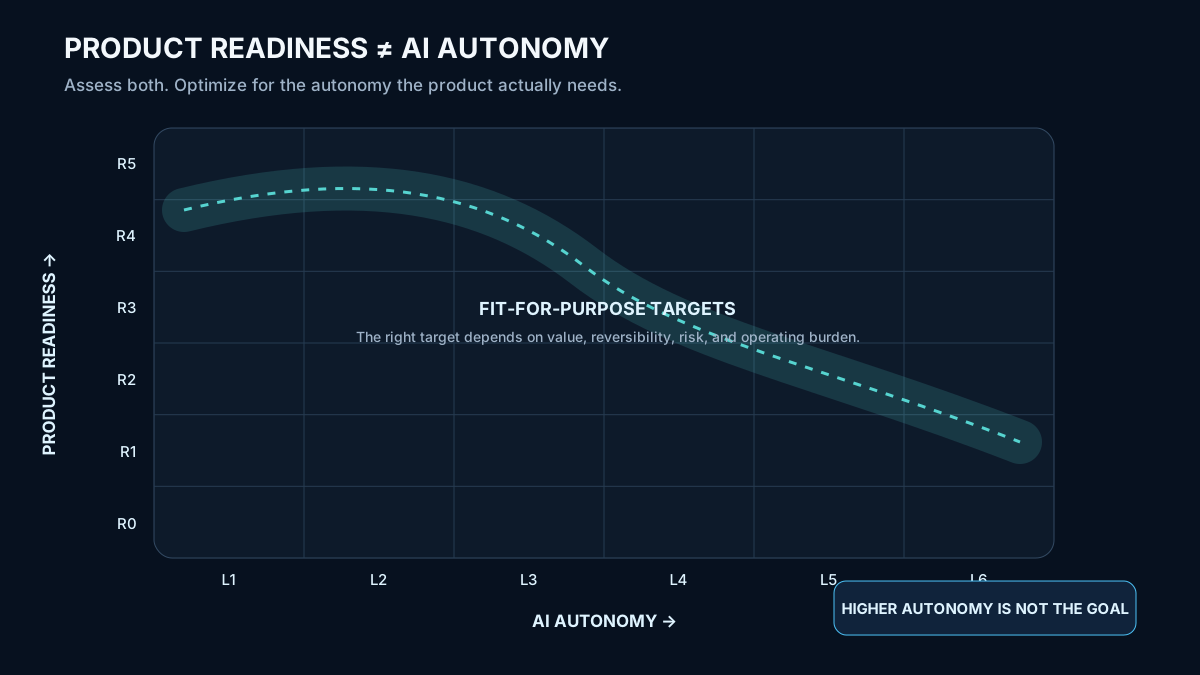
An R5 / L2 system can be exactly right. A mature product does not need more agent authority merely to improve its label.
Target autonomy: where should a product stop?
Before moving up a level, ask:
- Which recurring human burden disappears?
- How often does that burden occur?
- Can quality and failure be measured?
- Can failure be detected and reversed?
- What additional authority must the system receive?
- Is the value greater than the added cost, complexity, and risk?
If the answers are weak, higher autonomy may be an interesting architecture project but a poor product investment. More autonomy must not mean more model calls: deterministic code, cache, and structured data are often the more capable operational choice.
Human governance remains above every level
Good autonomy does not remove people from the system. It removes people from routine debugging and repetitive intervention while keeping them at decisions that carry accountability: public release, financial transactions, personal data, safety, external communication, and hard-to-reverse change.
“Founder is not the debugger” does not mean the founder stops deciding. It means the system must detect, classify, and handle ordinary failures at the level it claims, leaving the founder to own direction, risk, and genuine exceptions.
Human-protected approval is therefore compatible with high autonomy. Weakening a release gate to convert “blocked” into “pass” would reduce governance, not increase maturity.
Common anti-patterns
- Counting models or agents instead of operational responsibility
- Treating sophisticated CI and browser QA as proof of persistent agentic ownership
- Calling a fixed workflow an agent because one step uses an LLM
- Averaging scores until missing recovery or security disappears
- Treating
UNKNOWNorPARTIALas “probably passes” - Claiming L6 from one overnight run
- Adding model calls where code or cache is better
- Removing human approvals to make a maturity report look stronger
The SXP framework uses cumulative mandatory gates. UNKNOWN is not PASS; a partial gate cannot pass silently; and a claimed level cannot exceed the proven level.
What six SXP systems taught us
The v1.0 calibration deliberately produced different outcomes:
- Web and Analytics stop at lower target levels because additional runtime autonomy would add little product value.
- METAMI separates a deterministic child-facing product from its production and quality operations, which can own durable state, gates, audit evidence, and resume behaviour.
- Game Factory has automated play, soak tests, builds, and evidence-driven repairs, yet remains below L4 until workflow state and recovery control become durable.
- Commerce has a real private-beta workflow but does not claim a tool-using agent before an accepted action loop is observed.
- Studio proves an L4 production control system but stops short of L5 until measured quality can change routing in operation.
Maturity is not making every system reach the same number. It is proving the level that fits each job.
How to assess your own AI workflow
Choose one operational scope—“produce the weekly report,” not “our company”—then:
- Name its trigger, bounded goal, state, tools, and termination condition.
- Collect evidence from code, tests, runtime receipts, deployments, and incidents.
- Evaluate mandatory gates from L1 upward and stop at the first unmet gate.
- Assess readiness and assurance separately from autonomy.
- Select a target using real burden, measurable quality, authority, risk, and cost.
- Make the next investment close the first failed gate, rather than creating another architecture programme.
Report the result as a Likely Proven Level, with missing mandatory gates and a caveat. Do not call it certification.
Credible autonomy is not about how intelligent a system appears. It is about knowing what the system owns, how that ownership is evidenced, how failure behaves, how recovery is verified, and when the system must stop for a human decision.
แหล่งอ้างอิงและเอกสารปฐมภูมิ (Citations)
AI supported research, drafting, and consistency checks; the named author retains ownership of the conclusions and publication decision.